Frankenstein’s monster has once again come alive in Guillermo del Toro’s 2025 movie, “Frankenstein.” The movie stars Oscar Isaac as young Victor Frankenstein, Jacob Elordi as the creature, and Mia Goth as Elizabeth, and focuses on a fresher interpretation of the book compared to previous adaptations. The movie is extremely intentional in its production and cinematography, but takes major creative liberties regarding the plot structure.
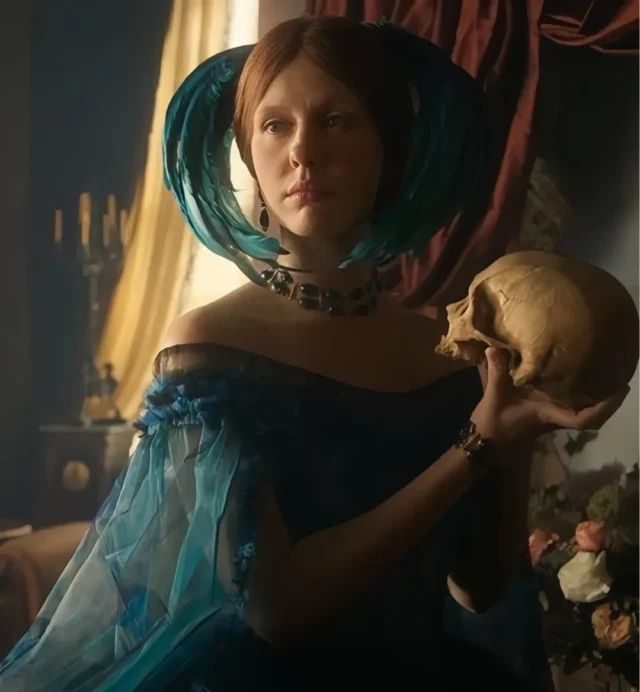
The cinematographer of the movie was Dan Laustsen who curates beautiful scenery and makes every detail have meaning to a story, even the clothes Elizabeth wears. In the beginning we are introduced to Elizabeth in a blue jade dress and feathers as a hair piece. The audience sees the significance of nature in her dresses from colors in nature such as blue and green. The blue dress includes patterns of butterflies while the green dress has a pattern inspired by beetles. The importance of these specific outfits is how she believes in the importance of the law of nature and used to reflect the interest she has in entomology.
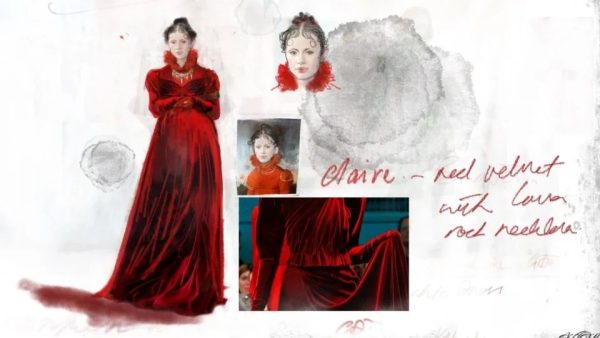
Another important character that is shown through the costuming is Baroness Claire Frankenstein, who is the mother of Victor Frankenstein. In the movie Claire is seen wearing a dark red dress and in every scene she is the color red makes its point to stand out. This crimson color is foreshadowing the blood and sacrifice that is to come. The red continues to show up even after her death in Victor’s dreams. Each dream is of an angel wearing a red robe connecting the angel to Victor’s mother. The death of his mother is what creates Victor’s obsession with reanimating the dead and playing God with life which is resembled with the religious symbolism of using an angel to represent his mom to justify his wrong doings. 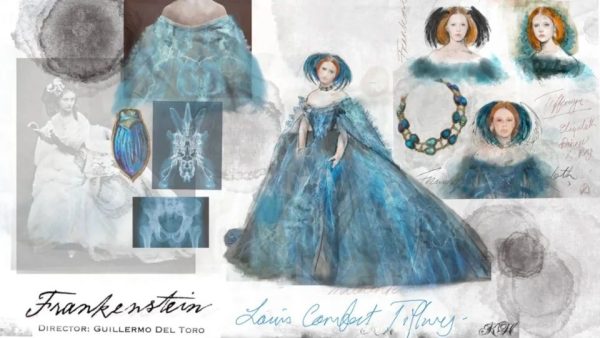
The symbolism of the character Elizabeth is also explored through her wardrobe; in the first meeting of Elizabeth she is in a hauntingly delicate blue gown that looks almost iridescent. The design of the dress is inspired by blue beetles and X-rays, which is an insight into Elizabeth’s love for the natural sciences, specifically insects, which is a motif throughout her wardrobe in the movie.
Mia Goth blue gown concept design (MEGA Magazine)
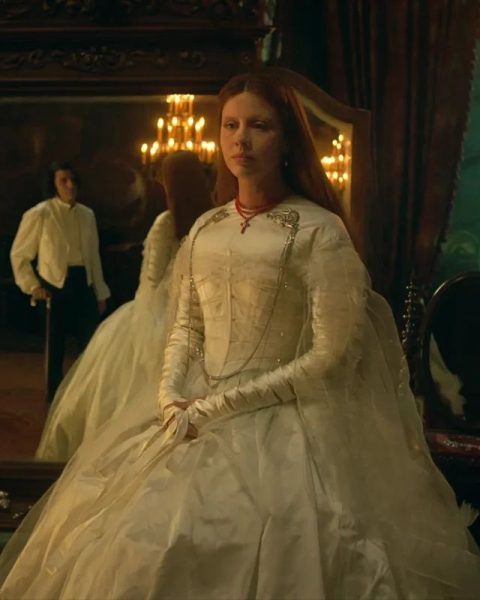
A beautiful scene that should be recognized is when the creature is carrying Elizabeth through the snow, in her white wedding dress, after she was shot by Victor. The color white in the scenery represents innocence and purity. The blood on Elizabeth’s wedding dress shows how Victor is the true monster who ruins the innocence around him, causing death and having pure hatred instead of purity.
The choices made in the new Frankenstein (2025) movie compared to the book Frankenstein by Mary Shelley added a more modern approach to the classic novel compared to previous films.
One of the most major differences of the film was the backstory and characterization of Victor.
In the novel Victor has a close relationship with his family, his mother’s death is traumatic for him, but he highly regards his father; depending on the print edition, Elizabeth is Victor’s maternal cousin, or an abandoned orphan who is taken under care by his family. The film essentially omits the character of Henry, who is Victor’s childhood friend, and re-imagines William, Victor’s baby brother. All of these familial relations are all but discarded in the movie which significantly impacts Victor’s character.
Victor’s hatred for his father and isolation in the movie create a hardened even more obsessive and jaded version of Victor in the film, the friendship and love of Henry and Elizabeth in the book which allow Victor his humanity are absent in the film and replaced with his obsession and entitlement.
Victor’s fixation with controlling death because of the loss of his mother is maintained from the text and even more evident in the movie as the film sees that Victor does not initially abandon his creation, but sees beauty in him at first. He only goes to abandon his creation when he does not feel the great alleviation of success that he had hoped for.
This exposes another major character difference in movie Victor versus book Victor; he feels little to no guilt in usurping the natural order. Obviously in both versions Victor ignores any ethical, moral, or natural issues that would stop him reconstructing a living being, but while in the book immediately feels regret and disgust, in the movie it takes him much longer to feel any sort of guilt and only does so when he realizes that his actions have consequences.
The intensity of Victor’s character in the movie is contrasted by Elizabeth, this is a key difference from the book in which Elizabeth is Victor’s love, comfort, supporter, and generally, an enabler. However, in the movie, Elizabeth is in many ways Victor’s foil. Elizabeth holds natural creation in the highest respect and in the movie represents this idea of seeing beauty in nature, and to Elizabeth, the creature is not a failure, but a miracle of life; Victor is who she sees as monstrous for his pride, disregard to the natural order, and his mistreatment of the creature.
The sharp turn to villanize Victor is shown through Elizabeth and her disdain for him as well as her death; on the night of her wedding, when Victor sees the creature in her room, he attempts to shoot it and ends up mortally wounding her instead. When the creature is confronted Victor blames it, and in contrast, the creature carefully takes Elizabeth away where she dies at peace. In the book, it is Victor and Elizabeth’s wedding that is ruined, and it is the creature that seeks out Elizabeth to strangle her to death. This is just one of many ways that the narrative of the movie has been shifted from the novel.
This works in the creature’s favor, as Victor leans further into the side of evil, the creature becomes even more of a sympathetic character, especially after omitting almost all of the outright vengeful moments he had in the book.
While the line between good and evil is extremely blurry in the novel, with the intent to make you question what it takes to be considered human, the movie feels more focused on the thematic elements of man playing God and the corruption that comes with power. However, this does not take away from the quality of the film. While the story is very different from Shelley’s original telling, it is still a deeply compelling commentary on human nature with the cinematography and beautiful aesthetics to back it up.
For more costume information: https://mega-asia.com/fashion/frankenstein-mia-goth/