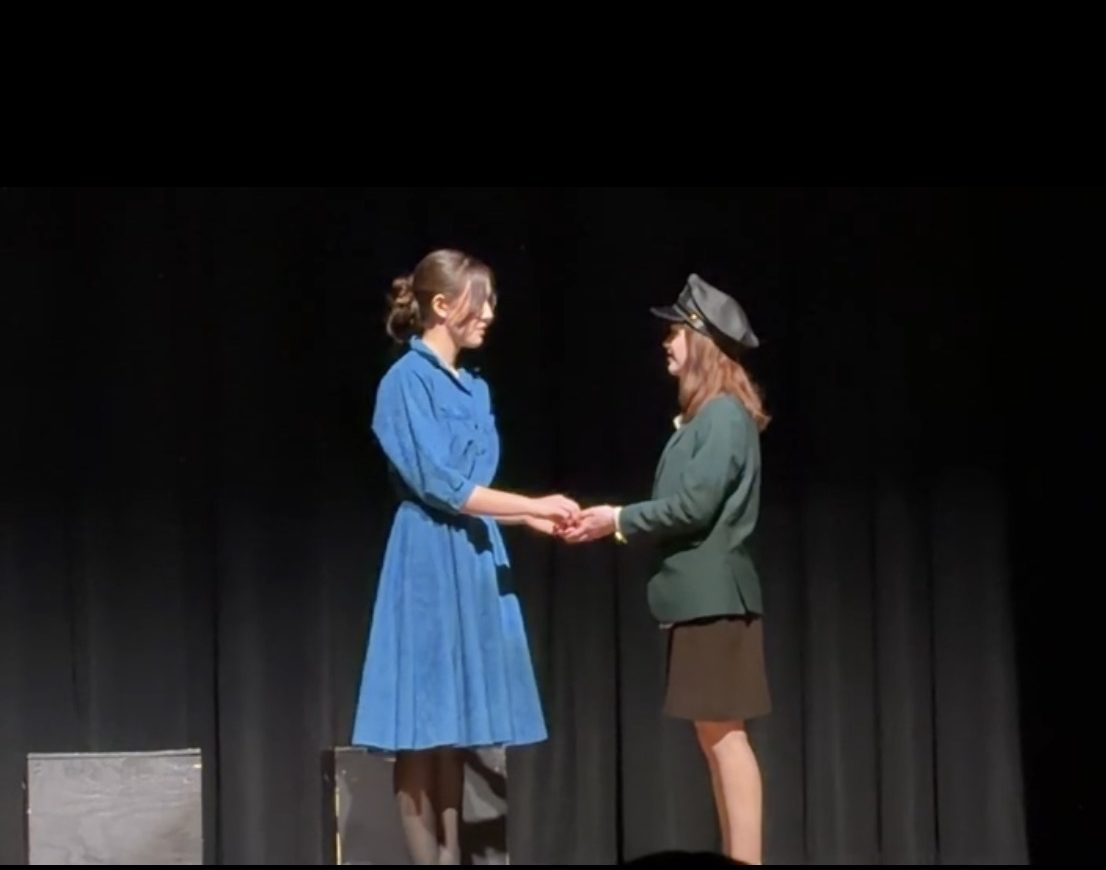
The true story of Noor Inayat-Khan, who worked in an English spy ring called the Special Operations Executive as a wireless operator during World War II, is told by Carli Wilkerson and William Kaskay in the form of a one-act play. The play follows her time training, her espionage operations in France, and then her eventual capture and execution by the Nazis. This play sets itself apart from previous Theatre on the Hill (TOTH) productions because it is written by Carli Wilkerson, Clover Hill’s theatre teacher, as well as William Kaskay, one of Clover Hill’s English and film teachers. The play was performed at the VHSL Theatre Sectional Tournament held at Meadowbrook High School on Feb. 4, and won first place. “Liberté!” went on to compete at VHSL Theatre Regional Tournament Glen Allen High School on Feb. 18, where they were the runner up.
Since this play was produced differently from previous Theatre on the Hill productions, Wilkerson shared what makes this one special to her.
“I’ve never written anything ever, play-wise. This is new to me because this is such an important story for me and I have been really anxious about it because I want people to see it for what it is, which is an incredible story of resilience and compassion but also love of country and saving lives,” Wilkerson said.
In 2023, Wilkerson went on a trip to Europe on a World War II tour; she had the opportunity to visit the concentration camp, Dachau. Wilkerson shared the moment she realized that the story of Noor Inayat-Khan and the other SOE agents must be shared.
“While I was there I was told by our tour director the story of these four women who were spies for England during World War II and were captured and then tortured for information, then were taken to Dachau and executed there. I was in the spot they were executed in and all I could think was ‘This story needs to be told’… And it’s been a very tough journey but really rewarding to write this,” Wilkerson said.
The process of writing a historic one-act play was a difficult task. It was a major undertaking for Kaskay and Wilkerson to navigate. Wilkerson explained how they approached it.
“It was a little bit longer of a process than I ever thought it would be. When Mr. Kaskay and I decided to write it, I knew it would take a lot of research and dedication and I need to give him credit for doing all of that research because I have a really hard time reading nonfiction and obtaining any sort of information from it. I bought all these books and he took on the task of researching and actually figuring out the timeline of her life and her fight with England against the Nazis. Working together, I was able to tell him how a script was written for stage versus a script for screen, because they are very different,” Wilkerson said.
Bringing this story to the stage was not a simple task for Wilkerson and Kaskay. Wilkerson explained the most difficult aspects of the writing process.
“I’d say the major difficulties were the same as before, what to keep in and what to keep out. Should we mention something that happened or not? On Mr. Kaskay’s side he’s used to writing screenplays and I’m used to reading stage plays so the thing is, we had to kind of collaborate and create things where like: he was used to doing a cutscene but we can’t do a cutscene because that’s not how stage works, so it was going back and editing in a way I had never edited before,” Wilkerson said.
“Liberté!” takes place in a dark time in history, in which most stories did not have happy endings. Wilkerson and Kaskay had to pay special attention to their mental well-being through the writing process. Wilkerson explained the difficulties faced while writing such a heavy topic and how she navigated those difficulties.
“Once you get into a topic like this you kind of, dissociating isn’t the word, but maybe disconnecting from it. Because the thing is: you’re writing a story, yes, and some of it might be a little embellished, but the thing is, you have to remember and ground yourself that these were real people’s lives. Noor, Madeline, Yolande, Elaine, they were all real women who worked really hard for their country and then ended up being executed. So, I think getting into that topic, sometimes we would make light of something or laugh about something when most people wouldn’t, but you have to do that when you’re writing something like this, because if you don’t it becomes too heavy and too hard to talk about it … so you have to take it but also try and make fun with it, not make fun of it, but make joy with it as well,” Wilkerson.
Going through the adventure of writing a play was an opportunity for growth for Wilkerson. She sheds light on how she has grown as a person from this experience.
“Now I know that I can write, I was always way too nervous to write my own show but having a partner like Mr. Kaskay makes things a lot easier. I know that writing it while knowing how I wanted it to be directed, how I wanted it to be staged, that made it easier, but I think that also helped me realize that I can do this! … as a person, as a director, once I was able to put the words onto the stage and actually put the motions and blocking and lighting design that I wanted with it, it made me feel like this could be something that was not just a one-act competition. It made me grow to believe in myself a little bit more,” Wilkerson said.
After putting so much time and effort into writing, the idea of “Liberté!” going beyond the one-act competition is not unfamiliar to Wilkerson and Kaskay. Wilkerson predicts the future of “Liberté!,” explaining her hopes for the play’s future.
“Me and Mr. Kaskay had talked about seeing if we can get it published by a play publishing company. Which I would love, I would love for this story to be told and I would love more one-act competition people to do that. I have sent a copy of it to Dachau, to their archivist team. I am also going to reach out to the Holocaust Museum of Richmond if they would like us to come perform there or maybe do a talk about it or something like that,” Wilkerson said.