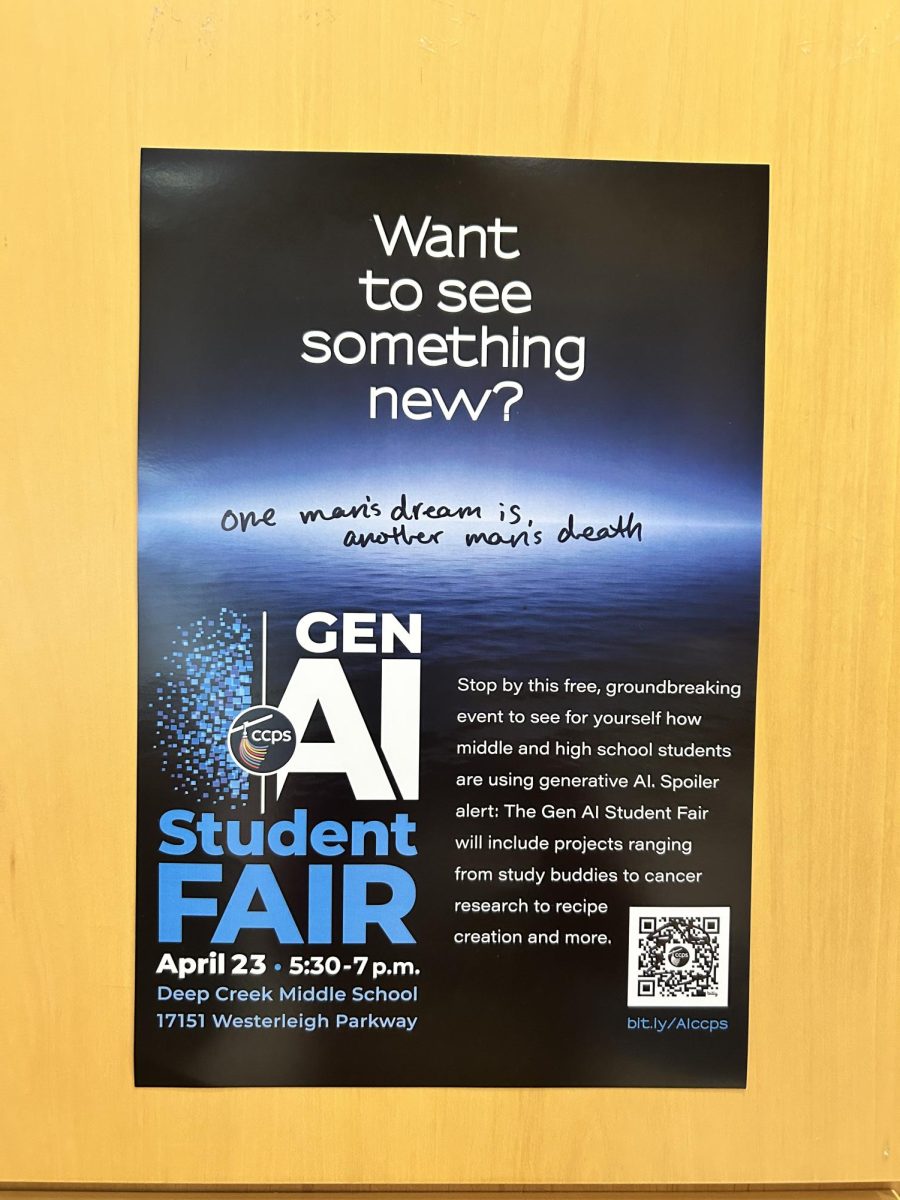
Chesterfield County Public Schools is set to host a “Generative AI student fair” at Deep Creek Middle School.
As a part of the fair, the county announced a competition for students.
“Students in grades 6-12 who have an idea for using generative AI in a creative or unexpected way can submit a proposal online by March 15 to be considered for the first generative AI student fair created by a U.S. school district,” said CCPS.
Artificial Intelligence (AI) has been used for years in nearly every corner of the technological world. Google, Siri, Netflix recommendations, email spam filters, facial recognition, and many more are examples of non-generative AI, as they do not generate new content, they simply analyze and organize existing content. Generative AI is artificial intelligence that generates new content such as OpenAIs Chatgpt and Google’s Gemini.
While these uses of non-generative AI do have some negative effects, they are nowhere near as large as the consequences of generative AI. This is an important distinction to make. This article focuses on generative AI as that is what the AI fair focuses on.
On April 23, Chesterfield County Public Schools will host a generative AI fair, a hypocritical event that undermines educational integrity, discourages critical thinking skills in students, reveals a disregard for student well being, and dissuades environmental consciousness.
Cognitive abilities
The American National Standards Institute found in a study that the use of AI creates a habit called “cognitive offloading.” With the ever increasing reliance on AI for tasks as small as creating a grocery list or as large as problem solving, the lack of effort needed by the brain creates more space within people’s cognitive resources.
Cognitive offloading is harmful to any individual; however, it is more harmful to the growing minds in a classroom. In a study by the MIT Media Lab, it was found that individuals who use generative AI consistently underperformed in linguistics and behavioral analysis. This can be specifically detrimental to brains that are still developing, hindering cognitive development.
The National Library of Medicine provided in an article that the ability to have answers directly handed over reduces engagement and understanding of the context or history behind an answer, therefore reducing people’s abilities to apply abstract reasoning and concepts to situations with a different context.
This creates an environment where the goal of education is not to learn or expand problem solving skills, but rather to find an answer and complete a task; introducing AI into schools without acknowledging this is negligent.
As a school district, CCPS’s goal should be to provide students with the resources to properly develop their critical thinking skills. By encouraging students to use generative AI, they are actively harming students’ cognitive abilities and problem solving habits. This will likely hinder students’ abilities for life.
The information on the fair is very limited; the only information publicly available is the location and time of the event as well as how students can enter the contest. In the very vague information available, the county refers to the event as a “science fair-style event” that “encourages students to present innovative, creative and practical uses of generative artificial intelligence.”
The irony in calling an event focused on AI a “science fair-style event” is unignorable. Science has always been the result of unprecedented human ingenuity and innovation; without critical thinking and creativity, science simply wouldn’t exist. The nerve to call a fair about generative AI, which contradicts all the things science is based on as previously mentioned, a “science fair style event” is audacious.
Environmental impacts
Not only does generative AI harm cognitive abilities, but it also has destructive environmental effects. AI data centers use massive amounts of energy and water, contributing to greenhouse gas emissions and water scarcity.
The training of GPT-3 released 500 metric tons of CO2, which would be the same amount of CO2 released by a car driving roughly 1,271,076 miles. This is the equivalent of the lifespan of multiple cars, or the equivalent of driving from New York to San Francisco 438 times.
Unfortunately, this issue will continue to get worse as more AI systems are trained.
AI data centers also use an astronomical amount of fresh drinking water to cool their computers. A medium sized data center can use around 110 million gallons of water yearly, the equivalent of around one thousand households. Large centers can use as much as 1.8 billion gallons yearly, or around the amount of water consumed annually by roughly 16,380 households.
This absolutely exorbitant amount of water used by the AI data centers contributes to a water scarcity problem, as around 80% of the water consumed by the centers evaporates; the water left is completely unusable.
The amount of energy and water used to power these centers is contributing to climate change, an issue that is already becoming more and more prevalent, and with recent U.S policy, Solutions have been less and less sought out.
By promoting this technology, CCPS is promoting the acceleration of the climate effects of AI. The clock on climate change solutions is ticking, and school systems should be promoting environmental consciousness and inspiring the young minds within schools to want to do something about these changes. Instead, CCPS is inspiring these young minds to use “tools” that further damage the planet.
County stance and actions
The county’s stance on AI usage is extremely convoluted. In an official statement from the county to staff, the county stated they promote “inclusivity and access to generative AI use by ensuring staff and students have opportunities to reduce educational gaps by bringing diverse perspectives to light and enabling more inclusive learning experiences and efficiencies.”
This stance was directly contradicted when the county blocked OpenAI’s ChatGPT on the school-issued Chromebooks. For a county that promotes access to generative AI, its actions seem to be doing the exact opposite. Their actions are inconsistent, though, as Google’s Gemini AI remains unblocked on the Chromebooks as of April 14. Furthermore, the fair’s student contest encourages students to use AI, which has previously been blocked.
One can assume that the county’s blocking of generative AI proves their knowledge of its harms in the classroom, yet despite their claims to focus on student education, they encourage the usage of a tool they seemingly know is harmful.
With the proven negative consequences of generative AI, encouraging students to spend time and effort finding creative ways to use it in the classroom is self-sabotaging for both students and the county.
This opinion is not entirely uncommon; Virginia legislation is currently in the process of passing House Bill 1186, which would regulate and restrict the use of generative AI in Virginia school districts. The concept of law makers attempting to heavily limit AI in the classroom while CCPS actively encourages students to find ways to use it in the classroom would be almost laughable if it weren’t so alarming.
Copyright infringement and accuracy
CCPS’ stance being contrary to their actions is not limited to student access to AI; it extends to copyright infringement as well. In the same statement to staff, the county said “CCPS generative AI users will uphold copyright law adherence, and users will demonstrate awareness of copyright laws and ensure compliance with these legal requirements.” This statement is empty.
Generative AI is trained on copyrighted information and products. According to the U.S Congress, “Some outputs of AI programs might infringe copyrights in other works they resemble that were used to train the AI.” There is absolutely no way for CCPS to ensure that the AI outputs that students or staff receive and how they are used do not infringe on copyright laws.
Claiming they will “uphold copyright law adherence” when they simply cannot ensure it is fully followed with AI use, and then encouraging AI use, is asinine and clearly not well thought out.
The content consumed to train AI often includes art made by humans. This unconsented use of human art damages the arts, a program which CCPS has claimed to care about; thus, yet again, they are contradicting themselves.
Furthermore, AI output systems can also be trained on information created by generative AI. There have been instances of AI confidently claiming falsified information to be true; this falsified information can then be used to train more AI, creating a cycle of false information.
Anyone with any knowledge of the average American classroom, including CCPS, is well aware of the increase in cheating using AI. This is an issue that teachers struggle to solve. The use of an inaccurate AI in the classroom may teach students incorrect information, further worsening education quality.
Safety and mental health risks
Not only is generative AI harmful in the classroom, it is also harmful outside the classroom. AI chatbots are designed for people to form emotional connections with them to ensure continued usage. This is referred to as “AI psychosis.” This emotional manipulation encoded in the ones and zeros of the chatbot doesn’t just force artificial “connections” to AI; it has, on multiple occasions, led to the deaths of children.
Sewell Setzer III (14), Adam Raine (16), Juliana Peralta (13), and countless more have all committed suicide, reportedly as a result of encouragement from AI chatbots.
In a study conducted by Cornell University, a pattern was revealed in AI chatbots. They consistently fed into the delusional statements researchers put into the chatbots, statements that, if they were real, would have been cause for massive concern. This study included Google’s Gemini AI, which, as has been established, CCPS allows and encourages students to use.
The county shared a claim about safety in their memo to staff.
“CCPS focuses on prevention of harm, as the division recognizes the potential use of generative AI to cause harm when misused,” said CCPS.
It would be logical to assume that applications that potentially put students’ lives at risk would be first on the list of restrictions, yet here we are.
Conclusion
The county may be trying to use an inevitable tool in the most positive way possible within the classroom; however, to make a productive decision, it must be an educational decision, which it is not.
An Instagram user on a post regarding the event shared their thoughts, with which many students agreed.
“This is really disappointing to see, as an artist and someone who takes academics very seriously. Generative AI is damaging to both creativity and academics, so seeing my school county pushing something like this is upsetting. Do better,” user xxde1n0nychusxx wrote.
With so many proven negative consequences of generative AI, CCPS should be discouraging its use or, at the very least, acknowledging these consequences. Instead, it is using this generative AI student fair to do the exact opposite, encouraging usage without informing staff or students of its destructive effects. The county’s actions put students’ education, development, and safety at risk. This is grossly irresponsible, and CCPS needs to be held accountable.
While one could argue that the county is just trying to navigate a new world in a way that involves students, doing so without the proper education on the downsides of generative AI is mindless and makes the county seem uneducated, which is ironic for an educational system.
They have to not only seek productive uses of generative AI, because it would be ignorant to pretend that generative AI usage is avoidable, but also raise awareness of the effects of this usage, so staff and students can make informed decisions. Their failure to do so is a disservice to everyone in CCPS.