


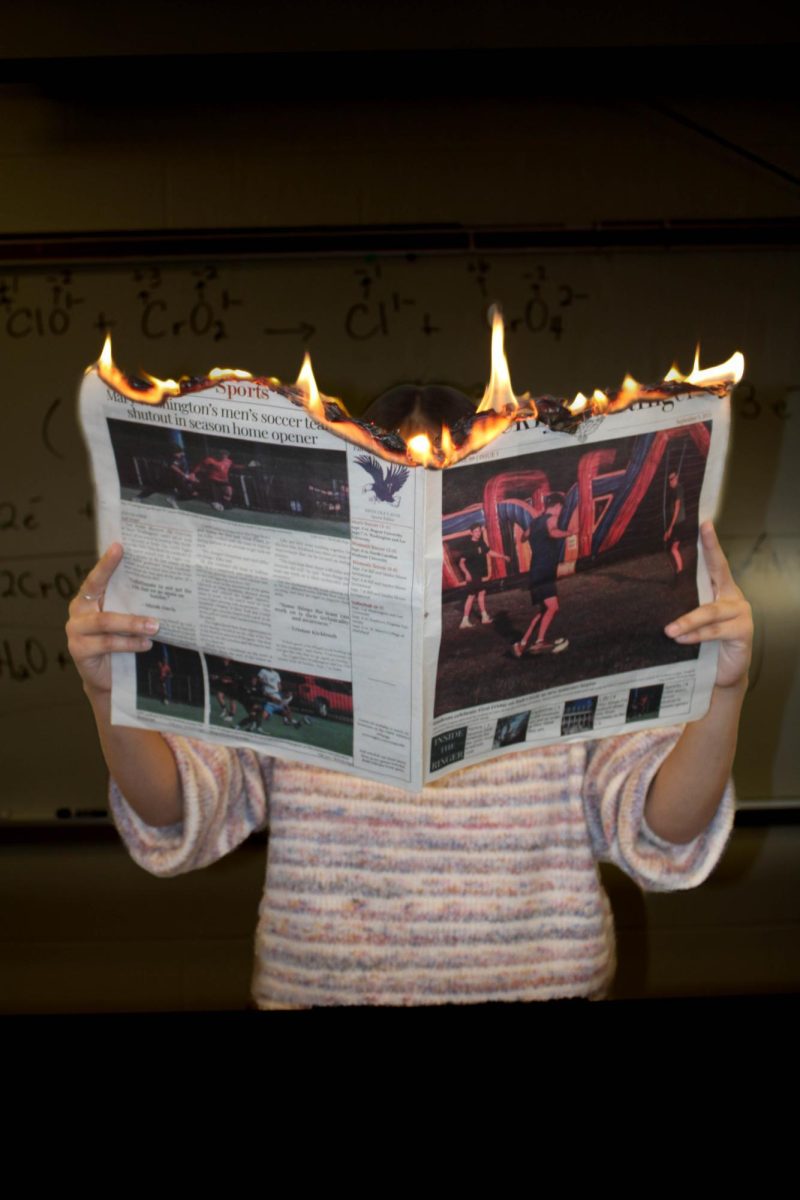
Free speech, hate speech, and the line between them have been heavily debated locally in recent months. Given the political tension our country is facing right now, politically controversial topics have faced censorship and many are claiming First Amendment rights, freedom of press and freedom of speech have been pushed.
Local officials have faced backlash from institutions for political social media posts, who cited lack of professionalism as the cause. The debate is not as black and white as it may seem though; many professional institutions that require their employees to sign contracts are well within their rights to limit certain kinds of public speech and penalize employees for breaking their contract. However, many have questioned if the repercussions have crossed the line of free speech violations.
An anonymous government teacher agreed to share their knowledge about the freedom of speech of teachers and students in Chesterfield County. For students, there is not a whole lot the county can do to restrict freedom of speech; however, for teachers in Chesterfield County Public Schools (CCPS), free speech becomes a grey area because of a clause in the teacher contract.
“It is fuzzy in Chesterfield because we have something called the morality clause,” the government teacher said.
In layman’s terms: the morality clause states that teachers must follow what is morally right. It is a very vague and open to interpretation piece of the contract, meaning it can be used to cover a broad range of subjects.
When under contract, freedom of speech changes depending on who the contract is with.
“Private corporations, you sign a contract with them. They can fire you for any reason that they want to, related to free speech, government has much more restrictions put in place,” the government teacher said.
Contract or no contract, free speech is not always a guaranteed right.
“The First Amendment protects your rights from the government. It says Congress shall make no law and so the first word is Congress, it’s saying that the government won’t take your rights away. It’s not saying you have an absolute right to say things,” the government teacher said.
Recently, within the community, many adults and youths have had their voices limited in the name of political pacification. But where is the line between censorship and a justified limitation drawn? An anonymous source within CCPS shares their view.
“You can’t be in a crowded place and yell gun, people are going to start panicking…as long as your words don’t negatively hurt someone, impact someone, or society [it is ok to utilize free speech],” source said.
The line falls somewhere along the boundary of intentional harm and simple disagreeableness. Possible lapses in this margin can be attributed to a lack of education on how to properly disagree and handle situations where opinions differ within the adult community, according to the source.
The source claims it’s “ironic” that teachers were required to teach students how to “disagree appropriately” via this year’s homeroom lessons, yet many adults are not very good at what they are requiring students to learn. This may reflect a larger issue regarding adult influence on youth. The actions of adults set an example for children, and the source believes that the current example being set is not ideal.
“If it continues to happen, then over time, we’re just modeling to the students that it’s not okay to speak up and say what you feel, expressing your First Amendment right,” source said.
It’s not just the boundaries of free speech on the stand; another First Amendment right — the freedom of the press — is being debated on both the professional level and the high school level.
Recently, this topic has been the subject of national news; in mid-October White House journalists were forced to decide whether or not to agree to a new set of rules created by the Pentagon. These rules would arguably breach freedom of press, such as by requiring reporters to only collect information approved by the administration. Reporters who failed to agree to these new terms were threatened with the loss of their press credentials. Many big name news organizations, including The New York Times, The Washington Post, PBS, The Guardian, CNN, The Atlantic, and The Associated Press, refused to agree to follow these new guidelines. Many of these publications are alleging that the changes are unconstitutional.
Cardinal News reporter Beth Beyers believes it is important for journalists to speak truth to power.
“I think journalists should run head first into reporting on disagreeable topics – as long as we’re able to do so objectively,” Beyers said.
With such vital pieces of our nation being so heavily debated, the future can look “bleak”. This is exactly why she believes the importance of journalism is on the rise.
“If anything, fact-based, objective journalism and a free press are more important now than ever before,” Beyers said.
The functionality of such an important aspect of our democracy can be questionable when it is at risk of suppression. Hence, the reason why Beyers believes censorship and restrictions on press are so damaging.
“There is no such thing as freedom of the press if journalists and news outlets are working under the threat of censorship, regardless of the topic,” Beyers said.
Recently, this issue has reached Virginia. A local student journalist was told by their educational institution to pull a story regarding a sensitive topic, bringing into question student publications’ right to freedom of press within schools.
The freedoms of the press do not entirely apply to high school publications, articles, and discussions are subject to suppression by school boards. In CCPS, publication curriculums are controlled by the school board.
According to the CCPS Student Services Policy 4101: Student Publications, in regards to possibly controversial topics, “Material that may be considered controversial by some members of the school community should be carefully considered by students, the appropriate faculty member, and brought to the attention of the school principal.”
Many other counties in Virginia follow the same general guidelines that do not on their own restrict the freedoms of the press, but give administrators the ability to do so. Because of this, it is not unheard of for school districts to prohibit the publication of certain hot-button topics.
Local Digital Content Producer Julia Broberg of WRIC ABC 8News believes that transparent reporting is a vital part of a journalist’s job.
“I think it’s a journalist’s job to provide unbiased reporting and approach something without either side tipping the scale,” Broberg said.
Given her history of reporting on jarring topics such as infant abuse in the NICU, sexual harassment claims, and restrictions on what can be printed on jerseys in schools, her opinion is that journalists have a responsibility to “explore all possible viewpoints of an incident.”
Broberg is not the only local journalist with valuable insight. Reporter Anna Bryson of the Richmond Times Dispatch shared her opinions on censorship in the news explaining the risks.
“I think it’s dangerous, I think it’s wrong… It’s not just a threat to journalists, it’s a threat to democracy,” Bryson said.
First Amendment rights are important, especially for journalists. Bryson commented on the rights of high school journalists.
“I 100% think they should have all the rights that any journalist has,” Bryson said.
Reporter for Courthouse New Services Joe Dodson shared a similar mindset, applied to the responsibilities of journalists.
“It would be really hard for us to do our job effectively if we didn’t have the protections afforded to us in the First Amendment… a big part of that is being free of censorship,” Dodson said.
In addition, Dodson shared his thoughts on what being a journalist entails and the responsibilities involved.
“Our jobs as reporters really comes down to accountability and it comes down to holding people, entities, businesses, politicians, and organizations accountable,” Dodson said.
Similarly, he believes that there is a line between journalistic responsibility and telling the full truth.
“It’s not my job to decide how a reader should react to the truth… My job is to tell the truth and sometimes the truth hurts, the truth can make people really upset,” Dodson said.
The First Amendment rights of freedom of press and speech are always subject to restrictions. However, the debate of where the line is drawn between reasonable suppression and unconstitutional actions is one that will continue to be discussed in the United States given the high levels of political tensions. What is free speech violation and what is a justified limitation is subjective, and really up to interpretation. While a society with a difference of opinion is a society that can grow and advance, the consequences of others interpretations is something that will continue to be a point of contention in our community.
One takeaway from this is that it is always important to stand up for what you think is right. If you see something you think is morally wrong or harmful, say something, take action. Abraham Lincoln’s long standing message, “for the people, by the people,” applies even today. Citizens have more power than many often think. The United States is the “land of the free.” Use your freedoms, hold authority accountable, and stand for what you believe in.
Kennedy Childress • Nov 24, 2025 at 9:28 am
Lily!! This is so good! I’m so so proud of you!!!
Hazel Lair • Nov 22, 2025 at 12:42 am
the dynamic between adults and youth is interesting here too. like theyre showing us how to treat each other, but at the same time youth are often the ones being censored or feeling the biggest impacts of it (like in school libraries or on the internet and especially queer youth, lots of ways young people are more susceptible to having important information cut off) while adults are the ones doing the censoring. so im curious if that may push youth to be more bitter about it and hopefully to see the flaws in the idea of censorship